Japan
Ancient traditions, futuristic cities, incredible food and landscapes that change dramatically with the seasons. Japan is one of those destinations that can feel completely different depending on when you visit and how you choose to explore it.
How to Get Around Japan: Trains, IC Cards, Google Maps & More
Japan’s transport system can look complicated when you first start planning a trip. There are different train operators, several types of trains, IC cards, Shinkansen, buses and a lot of very large stations to navigate.
The good news? You don’t need to understand all of it before you go.
Once you know how to use an IC card, book a Shinkansen and navigate with Google Maps, getting around Japan becomes surprisingly straightforward. And when you’re working with limited annual leave, Japan’s fast and reliable trains make it possible to see several places without losing entire days to travel.
Here’s everything you need to know to get around Japan.
Getting Around Japan at a Glance
For most trips, you’ll use a combination of:
You don’t need to choose one method for your whole trip. In fact, you’ll probably use several.
The Shinkansen: The Best Way to Travel Between Major Cities
If you’re planning to visit more than one part of Japan, you’ll probably end up on a Shinkansen, Japan’s famous bullet train.
They’re fast, comfortable and make travelling between major cities much easier than you might expect.
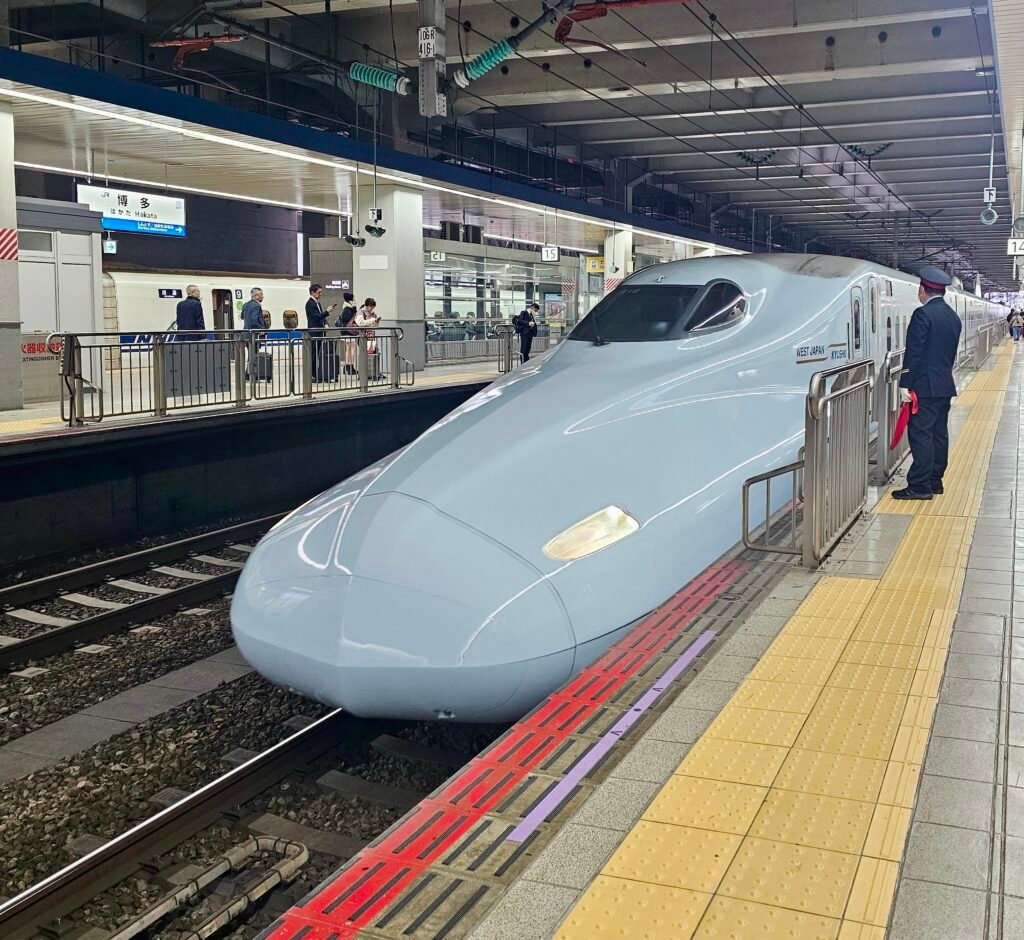
Approximate Shinkansen journey times
| Route | Approx. journey time |
| Tokyo → Kyoto | 2h 15m |
| Tokyo → Osaka | 2h 30m |
| Tokyo → Nagoya | 1h 40m |
| Tokyo → Hiroshima | 4h |
| Tokyo → Sendai | 1h 30m |
| Kyoto → Hiroshima | 1h 40m |
| Osaka → Hiroshima | 1h 30m |
| Tokyo → Hakata (Fukuoka) | ~5h |
Times vary depending on the service and exact route, so always check your specific train when planning. The useful thing about these journey times is that they can completely change how you think about your itinerary.
For example, Tokyo → Kyoto is only around two hours by Shinkansen, meaning you can spend your morning exploring Tokyo, travel to Kyoto around lunchtime and still have the afternoon and evening there.
That’s one of the reasons Japan works so well for a shorter trip.
Reserved or non-reserved seats?
When booking a Shinkansen, you’ll generally come across reserved and non-reserved seating. Some services are reserved-seat only.
A reserved seat gives you a specific seat on a specific train, while non-reserved seating means you use the designated carriages and take an available seat.
For a first trip to Japan, I’d personally keep things simple and book a reserved seat when you already know which train you want to take.
You can book Shinkansen tickets online or at stations, depending on the route. The official SmartEX service, for example, allows international visitors to book certain Shinkansen journeys online.
When should you book?
You don’t necessarily need to book every Shinkansen weeks or months in advance. However, if you’re travelling during a busy period or know you want to take a particular train, booking ahead gives you more certainty.
This is particularly useful if your itinerary is tightly planned around your annual leave. You don’t want to arrive at the station and discover that the train you planned your day around isn’t the one you can board.
Travelling with a large suitcase?
This is worth checking before you travel. On some Shinkansen routes, including the Tokaido, Sanyo and Kyushu Shinkansen, luggage with total dimensions over 160cm requires an appropriate oversized-baggage arrangement (special seat booking).
If you’re travelling around Japan with a large suitcase, check the luggage rules for your specific train when booking.
One of my biggest tips for a multi-city Japan trip is don’t carry a huge suitcase everywhere if you don’t have to. Japan has luggage forwarding services that allow you to send your bags between hotels or other destinations, meaning you can travel between cities with just a smaller overnight bag.
There are also coin lockers at many stations and tourist facilities. Sizes and prices vary, but lockers commonly cost around ¥300–¥1000 depending on size. They can fill up quickly in busy locations, so don’t rely on finding one at the last minute in a particularly popular area. If you’re planning a trip with several hotel changes, luggage forwarding is definitely something I’d look into.
Do You Need a Japan Rail Pass?
The Japan Rail Pass used to be an almost automatic recommendation for visitors travelling around Japan. That’s no longer necessarily the case. Whether a JR Pass makes sense depends entirely on your itinerary, the number of long-distance journeys you’re taking and which trains you plan to use.
If you’re doing something relatively simple like: Tokyo → Kyoto → Osaka it’s worth comparing the cost of individual tickets before buying a pass.
If you’re travelling much further and taking several long-distance journeys, the calculation may be different. Don’t automatically buy a JR Pass just because you’re travelling around Japan. Work out your itinerary first, then compare the costs.
Rather than trying to work out the costs yourself, you can use this Japan Rail Pass calculator to enter your planned journeys and compare the cost of individual tickets with the different rail passes available. It’s a quick way to see whether a pass could actually save you money based on your itinerary.
IC Cards: The Easiest Way to Pay for Everyday Transport
If there’s one thing I’d recommend sorting out early in your Japan planning, it’s an IC card. IC cards are rechargeable travel cards that you can use on much of Japan’s public transport network. Depending on the card and location, they can be used on trains, metro systems and buses, as well as for smaller purchases such as convenience stores and vending machines.
You’ll come across names such as:
- Suica
- PASMO
- ICOCA
- TOICA
You don’t need to get caught up in which card belongs to which railway company. Most major IC cards can be used across a wide range of transport services, although there are still some regional and service-specific restrictions.
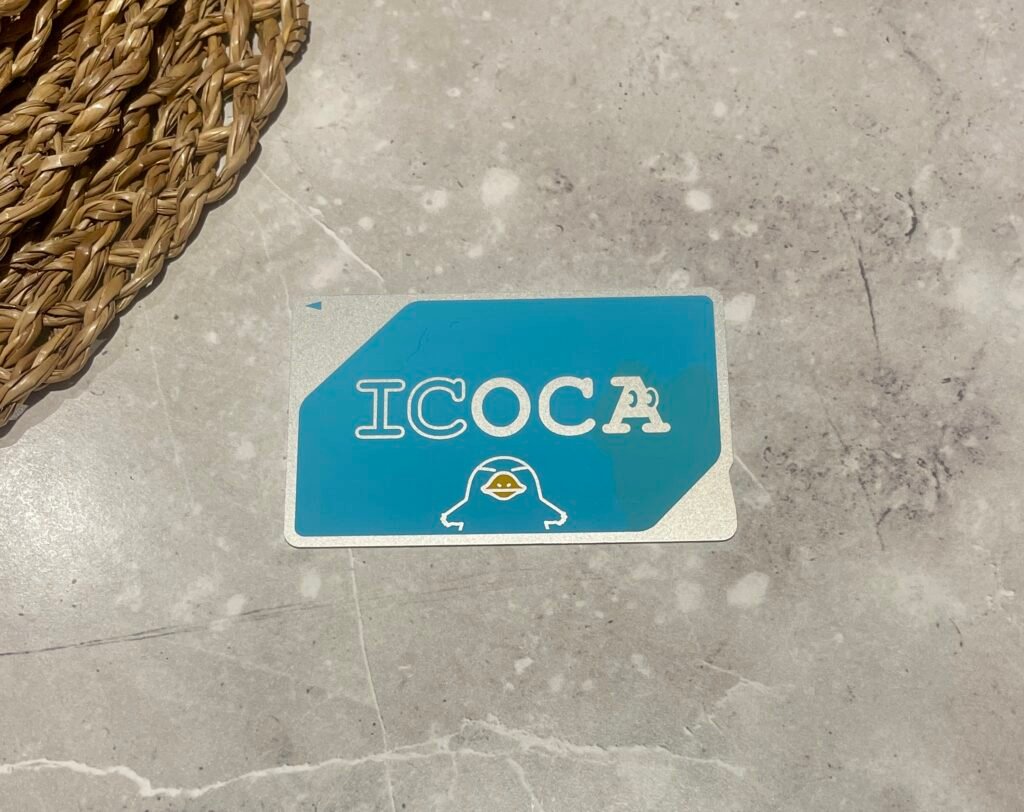
Physical or digital IC card?
If you have a compatible smartphone, you can use a digital IC card instead of carrying a physical one. On iPhone, for example, you can add a Suica, PASMO or ICOCA to Apple Wallet and use your phone to tap in and out of stations.
I used a Suica on my iPhone and found it incredibly convenient. Being able to top it up directly from my phone whenever I needed to meant I never had to worry about finding a machine or carrying cash just to add money to my transport card. You can simply top it up and tap your phone at the gates.
Android users can also use mobile IC cards on compatible devices, although availability depends on the phone model.
Prefer to keep things simple? A physical IC card works perfectly well too, so you don’t need a compatible smartphone to use Japan’s IC card system.
One important thing to remember
An IC card doesn’t replace every type of train ticket. It’s perfect for everyday journeys on eligible local trains, metros and buses, but you’ll generally need a separate ticket or reservation for longer-distance journeys such as the Shinkansen.
Think of your IC card as your everyday transport wallet, rather than your all-purpose Japan train ticket.
Using Trains & Metro in Japanese Cities
Once you’re in a city such as Tokyo or Osaka, you’ll probably spend most of your time using local trains and metro systems. Tokyo can look particularly intimidating on a map. There are JR lines, Tokyo Metro, Toei Subway and private railway lines, all connecting different parts of the city.
But here’s the important part: You don’t need to memorise the network.
You just need to know where you’re going, that’s where Google Maps comes in.
Google Maps: Your Best Friend for Getting Around Japan
Google Maps is one of the apps I’d make sure to have ready before travelling to Japan. Japan’s train network can look a little overwhelming when you first see it, especially in Tokyo, but you really don’t need to understand the whole system yourself. Google Maps does most of the work for you.
It can tell you:
- Which train to take
- Which line to use
- Where to change
- Which platform to go to
- How long the journey will take
- Walking directions to and from stations
- Approximate fares
And in my experience, the stations themselves are much easier to navigate than you might expect. There are signs everywhere, and once you know which line and platform you’re looking for, it becomes fairly straightforward. Just follow the signs and double-check the train destination before you board.
My tips for using Google Maps in Japan
Save your accommodation.
This sounds obvious, but it’s particularly useful in larger cities where stations can have multiple exits. Google Maps can help you work out which exit is closest to where you’re actually going.
Save the places you want to visit.
Restaurants, cafés, attractions and shops can all be saved before your trip. I find this particularly useful when planning each day because you can see what is close together rather than constantly crossing the city.
And if you want to spend less time researching and more time exploring I have done the research for you.
→ Explore the Japan Travel Map
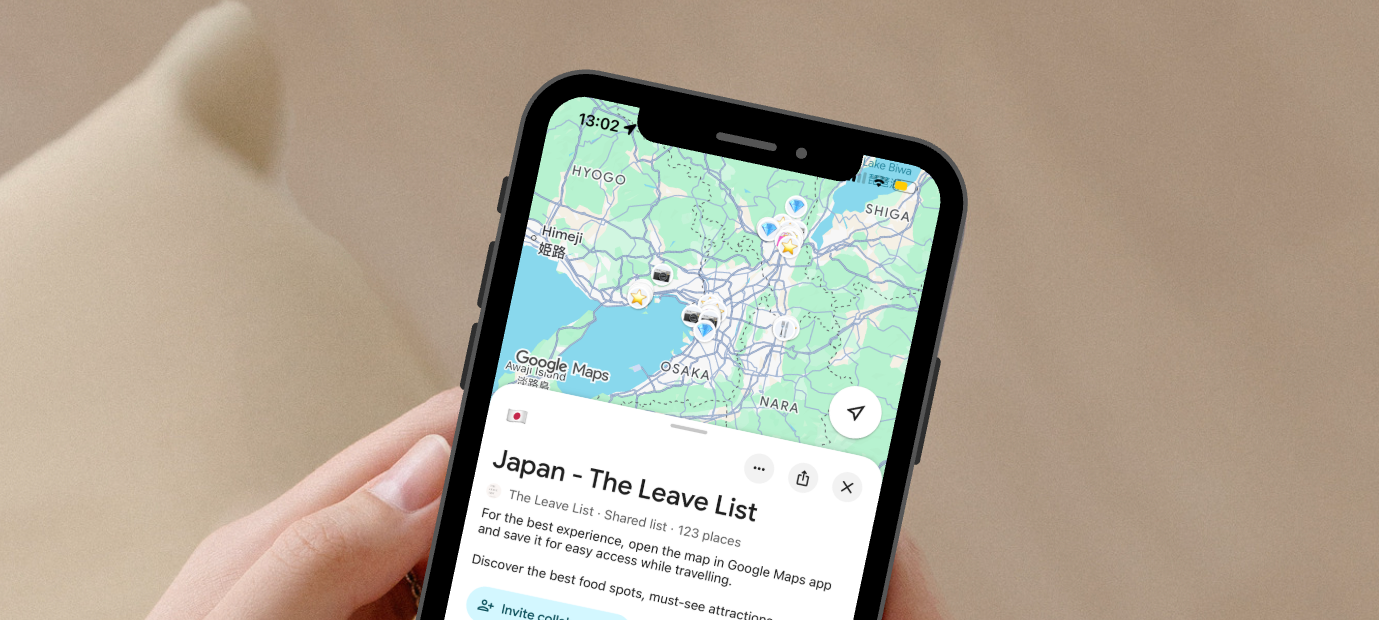
Check the whole journey.
Google Maps will usually give you several options, so look at the entire journey rather than just the train itself. Check how many changes you’ll need, how much walking is involved and how long the journey takes.
Don’t panic if a station looks huge.
Some Japanese stations are enormous, but they’re well signposted. Give yourself a little extra time when you’re somewhere new, especially for your first few journeys, and you’ll quickly get the hang of it.
Keep your phone charged.
It sounds obvious, but when you’re relying on Google Maps to navigate a new city, a dead phone is the last thing you want. A portable charger is definitely one of my travel essentials.
The first time you look at a Tokyo train map, it can look like complete chaos. Once you have Google Maps open and know what line, platform and direction you’re looking for, it’s actually much simpler than it looks.
Buses in Japan
Trains aren’t always the easiest way to reach every attraction.
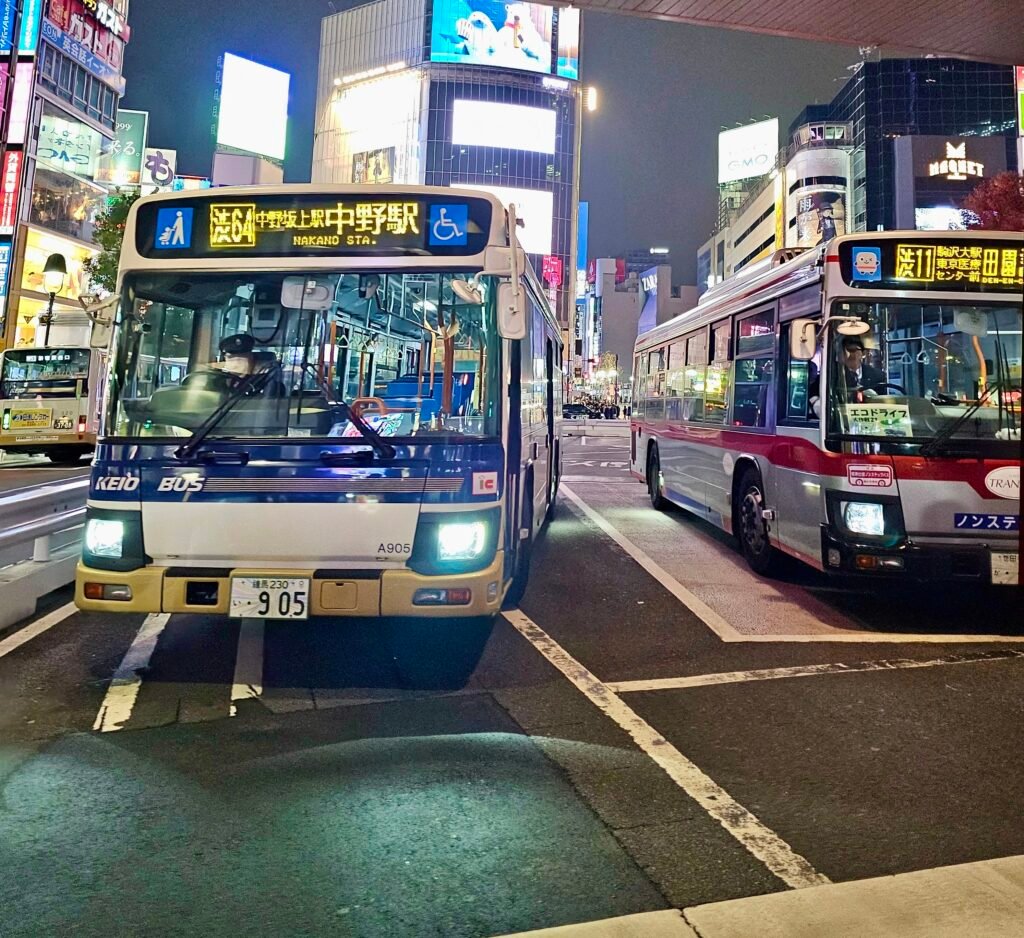
Buses are particularly useful in places such as Kyoto, Hakone, the Mount Fuji area and more rural destinations.
Google Maps can usually help you work out which bus you need, but don’t assume every bus accepts IC cards. Check for the IC symbol when boarding or at the bus stop, and keep some cash with you just in case.
In some places, buses work slightly differently from what you might be used to at home, so don’t worry if the first one feels confusing. Follow the signs, check your destination and watch what other passengers are doing. You’ll get the hang of it quickly.
Taxis in Japan
Japan’s taxis are reliable and useful, but they’re considerably more expensive than using public transport. They’re particularly handy when:
- You’re travelling with several bags
- You’re arriving late
- Your accommodation is far from a station
- You’re travelling as a group
- You’re visiting somewhere with limited public transport
You don’t need to use taxis for everyday sightseeing, but they can be worth it when convenience matters more than saving a little money. And after a long travel day, sometimes getting dropped directly at your hotel is worth it.
What About Domestic Flights?
For some journeys, flying makes more sense than taking the train. This is particularly relevant if you’re travelling to destinations such as:
- Hokkaido
- Okinawa
- Some parts of Kyushu
- Other destinations that require a very long train journey
For a classic first trip such as Tokyo → Kyoto → Osaka, however, the Shinkansen is usually the more natural option. For longer trips around Japan, compare both options rather than automatically assuming the train is best.
Remember to factor in the time needed to get to the airport, check in and travel from the arrival airport into the city. The shortest flight time isn’t necessarily the shortest overall journey.
A Few Things to Know Before Using Public Transport in Japan
Public transport in Japan is generally quiet and orderly, and there are a few simple things worth knowing.
- Keep your phone on silent and avoid phone calls on local trains.
- Let passengers off before you board.
- Queue where indicated on the platform.
- Avoid blocking train doors with luggage.
- Take backpacks off in crowded trains where possible.
- Keep conversations relatively quiet.
- Eating and drinking are generally fine on Shinkansen, but aren’t something you’d normally do on a busy city train.
You don’t need to overthink Japanese train etiquette. A little awareness goes a long way.
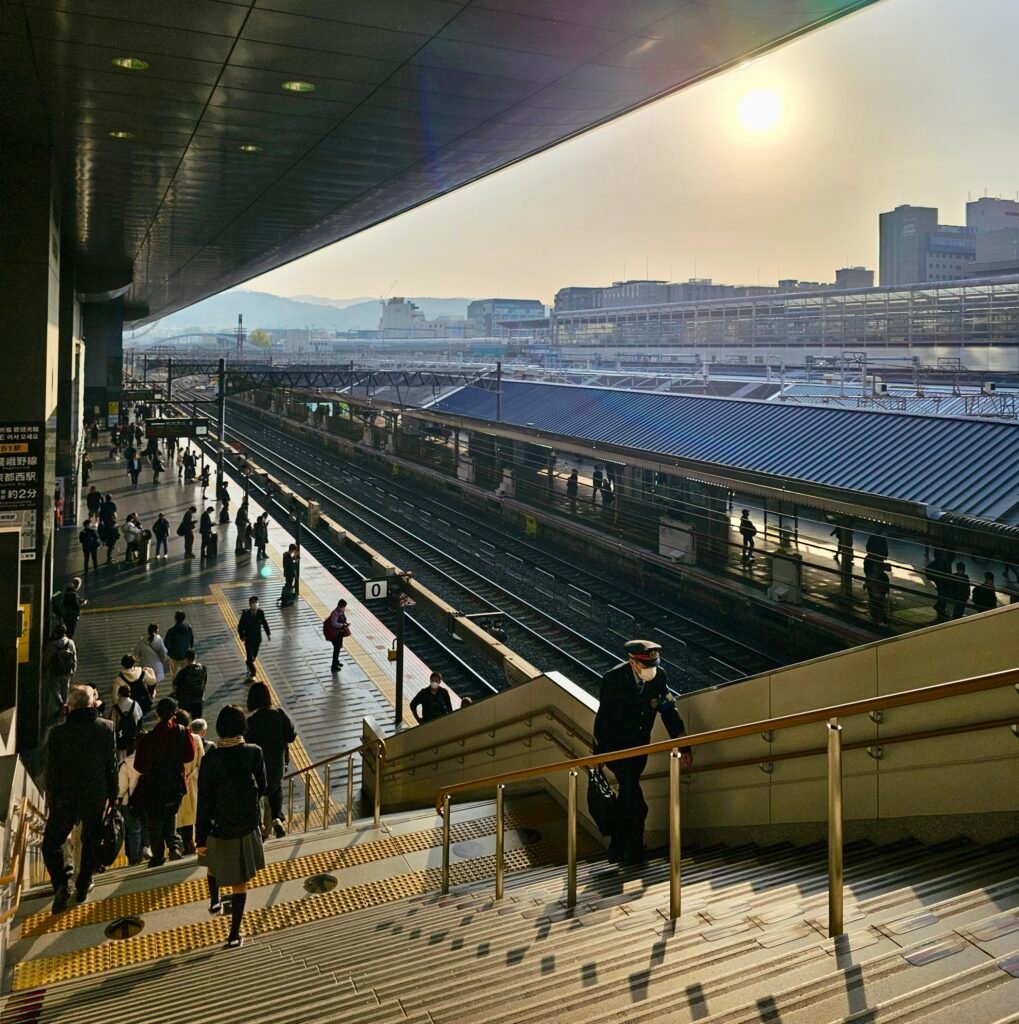
So, What’s the Best Way to Get Around Japan?
For most travellers, getting around Japan comes down to a simple combination:
Shinkansen for the big journeys.
Trains and metro for exploring cities.
An IC card for everyday transport.
Google Maps for figuring out the rest.
And that’s really all you need to know before you go. Japan’s transport system can look complicated when you first start planning, but you don’t need to understand every railway company, train line or ticket type before arriving.
Once you’ve used your first IC card, navigated your first station and stepped onto your first Shinkansen, it all starts to make a lot more sense.
And if you’re travelling with limited annual leave, that’s the real advantage: Japan’s excellent transport network means you can spend less time getting from A to B and more time actually exploring.
Find out more
Ready to plan your Japan trip ?
Now that you’ve explored where to go, it’s time to start putting your trip together.
More about Japan
When to go
How long should you stay